I recently volunteered to work as the release manager for the 0.9 and 1.0 releases of the incubating Apache Jackrabbit project. The 0.9 part of this task was finished yesterday when I officially announced the release of Apache Jackrabbit version 0.9. The process leading up to the release announcement has been an interesting and educating one.
I first got involved with the Jackrabbit project in November 2004 when I announced an initial version of the JCR-RMI layer I had been working on. Based on positive feedback I started getting more and more active on the mailing list and continued working on JCR-RMI. My work was rewarded with committer status almost exactly a year ago in February 2005. Since then I've been working on various parts of Jackrabbit although I have still to touch the deep internals of Jackrabbit core. I got another reward for my work when I was invited to join the expert group of JSR 283: Content Repository for JavaTM Technology API Version 2.0.
Talk of making a Jackrabbit 1.0 release started sometime in summer 2005 after the JSR 170 had stabilized the JCR API. There was however not too much activity towards a release so I decided to start pushing things in late September. This sparked some discussion and concerns about some of the open issues. The Jira roadmap for 1.0 started to grow bigger and bigger as more issues were filed. I finally solved this problem in November by setting up a separate 1.1 goal for the more complex issues.
Despite these efforts and a lot of ongoing development work there still wasn't too much happening toward an initial release. This situation changed in January when Roy suggested that a 1.0 release plan might be a good thing to have. I volunteered to act as the release manager and based on the resulting discussions I published the Jackrabbit 0.9 release plan in late January. The idea (as suggested by Roy) was to first make a 0.9 release to streamline the release process for a 1.0 release soon after 0.9.
After working a while with making the build environment better fit the release needs I announced a 0.9 release candidate. Making the release candidate had me reading through a number of release guidelines on the various Apache websites and refreshing my GnuPG skills. All Apache releases are digitally signed so I needed to set up my own key. I also got my key signed by Roy, so I expect my key to show up in the Apache web of trust in a few days.
There was only one issue that got fixed between the first release candidate and the version I posted for the official release vote. The release vote passed with no objections, but then Roy suggested a few packaging changes before endorsing the release as required by the Incubator policy. I made the changes, and since no source files were modified there was no need to restart the release vote. Roy then proceeded to request and receive approval for the release from the Incubator PMC.
After the approval we placed the release under cvs.apache.org where incubating projects are allowed to publish their releases. I then updated the Jackrabbit web site and sent the release announcement. The next step the more challenging 1.0 release on which I'll start focusing tomorrow.
Wednesday, February 15, 2006

Sunday, February 12, 2006
The joy of troubleshooting
How to troubleshoot a problem in a computer system? There are a number of standard troubleshooting methodologies like trial-and-error, bottom-up, top-down, divide-and-conquer, and even root cause analysis, but none of them is a silver bullet for all possible problems. Often the most effective way is to dynamically combine these approaches based on experience and understanding of the underlying technologies. This is a story of a particularly hard problem with an unexpected cause that I troubleshooted recently.
The problem I was facing was related to a Midgard staging/live setup using the Exorcist tool. The staging site was working just fine but the live site was having weird problems on some pages. It appeared as if the MidCOM components of the troublesome pages were losing a part of their configuration parameters.
Step 1. Because everything was working fine on the staging site I figured that the problem is most likely related to the staging/live replication step performed using the Exorcist. Were the parameters not being replicated? None of the common causes for such situations (unapproved content, parameters in a different sitegroup than the main object, etc.) seemed to apply however so I had to inspect whether the replication dump actually contained the missing parameters. It did!
Step 2. So the parameters were being replicated, but was there some trouble in how they were being imported in the live database? There was nothing strange in the import log file, so I opened a MySQL prompt to inspect the live database. The troublesome parameters seemed to exist just where they should be, and they even had all the correct GUID mappings and other details that had previously caused problem with the Exorcist.
Step 3. It seemed that the live database was in perfect condition, so the problem must be caused by something else. The problem was affecting just some MidCOM components, so I figured that there might be some difference in the component versions used on the staging and live hosts. No, the MidCOM source trees on both the staging and live hosts were identical.
Step 4. If the problem wasn't with MidCOM, then it must be a problem with the Midgard framework. Adding debug prints to one of the troublesome MidCOM components I was able to narrow down the problem to a
Step 5. I added a set of debug prints to the Midgard-PHP listparameters method, compiled and installed the modified module, and reloaded the troublesome pages. They still didn't work properly, but now I got a detailed trace of what was happening under the hood. The method actually did execute the correct SQL query but received no results from the database. This was certainly weird, as I was very certain that the parameters in question actually did exist.
Step 6. Could there be something wrong with the MySQL client library used by the Midgard core to send queries to and receive results from the database? The normal MySQL command line tools use the same library so I started the MySQL prompt and entered the SQL statement copied from the Midgard log file. No results! The SQL statement was:
Step 7. There are some autogeneration artifacts in the query, but no real reason why it shouldn't work. I removed the
Step 8. Could this be some weird character set and collation issue like the ones we've been facing recently? No, it works the same way (rows are returned or not returned depending on whether the ORDER BY clause is used) regardless of the character encoding being used.
Step 9. Has the database been corrupted? I backed up and restored the entire database but the query was still misbehaving. I then copied the correctly behaving database from the staging host to the live host. The same error appeared in that database as well!
Step 10. The staging host was running MySQL version 4.1.12 while the live host had MySQL 4.1.7. Both stable and tested releases installed from the standard RHEL packages. I was recalling ugly memories from the MySQL 3.x times, when weird database errors seemed to be much more common.
Step 11. OK, it seemed that the problem was some MySQL bug that got fixed somewhere between versions 4.1.7 and 4.1.12. I didn't want to risk messing with the database installation so I figured I'd better find some workaround rather than trying to upgrade the database version.
Step 12. I used the EXPLAIN statement trying to find out what could be triggering the MySQL bug. The output suggested that the query planner was using some of the indexes on the record_extension table. The indexes actually look quite weird:
The indexes don't seem to be reasonable. Why the arbitrary ten character limit, and why use only a single column per index? This seems anomalous enough to trigger an obscure bug in MySQL, so I just dropped the record_domain_tablename_idx index. And it worked!
The entire troubleshooting session took about three hours with a couple of breaks in between.
The problem I was facing was related to a Midgard staging/live setup using the Exorcist tool. The staging site was working just fine but the live site was having weird problems on some pages. It appeared as if the MidCOM components of the troublesome pages were losing a part of their configuration parameters.
Step 1. Because everything was working fine on the staging site I figured that the problem is most likely related to the staging/live replication step performed using the Exorcist. Were the parameters not being replicated? None of the common causes for such situations (unapproved content, parameters in a different sitegroup than the main object, etc.) seemed to apply however so I had to inspect whether the replication dump actually contained the missing parameters. It did!
Step 2. So the parameters were being replicated, but was there some trouble in how they were being imported in the live database? There was nothing strange in the import log file, so I opened a MySQL prompt to inspect the live database. The troublesome parameters seemed to exist just where they should be, and they even had all the correct GUID mappings and other details that had previously caused problem with the Exorcist.
Step 3. It seemed that the live database was in perfect condition, so the problem must be caused by something else. The problem was affecting just some MidCOM components, so I figured that there might be some difference in the component versions used on the staging and live hosts. No, the MidCOM source trees on both the staging and live hosts were identical.
Step 4. If the problem wasn't with MidCOM, then it must be a problem with the Midgard framework. Adding debug prints to one of the troublesome MidCOM components I was able to narrow down the problem to a
$object->listparameters($component) call in the MidCOM configuration class. The configuration class seemed to be working just fine everywhere else, so the problem must be in the listparameter method! For some object/component combinations the method just returned nothing and didn't log any errors even though I double- and triple-checked that the parameters existed in the database.Step 5. I added a set of debug prints to the Midgard-PHP listparameters method, compiled and installed the modified module, and reloaded the troublesome pages. They still didn't work properly, but now I got a detailed trace of what was happening under the hood. The method actually did execute the correct SQL query but received no results from the database. This was certainly weird, as I was very certain that the parameters in question actually did exist.
Step 6. Could there be something wrong with the MySQL client library used by the Midgard core to send queries to and receive results from the database? The normal MySQL command line tools use the same library so I started the MySQL prompt and entered the SQL statement copied from the Midgard log file. No results! The SQL statement was:
SELECT id,domain,name,value FROM record_extension WHERE (tablename='topic' AND oid=27 AND domain='de.linkm.sitemap' AND lang=0) AND (record_extension.sitegroup in (0,2)) ORDER BY nameStep 7. There are some autogeneration artifacts in the query, but no real reason why it shouldn't work. I removed the
domain='de.linkm.sitemap' constraint and got a list of parameters, including ones with the domain column set to de.linkm.sitemap! Even worse, the exact same query with domain='midcom' or domain='midcom.helper.nav' were returning results, for some totally unknown reason MySQL seemed to not like the domain='de.linkm.sitemap' constraint. I tried also some other variations of the query and found out that even just removing the ORDER BY clause made the query return the correct rows. This should ring heavy warning bells for anyone who knows SQL, as the ORDER BY clause only orders the returned rows.Step 8. Could this be some weird character set and collation issue like the ones we've been facing recently? No, it works the same way (rows are returned or not returned depending on whether the ORDER BY clause is used) regardless of the character encoding being used.
Step 9. Has the database been corrupted? I backed up and restored the entire database but the query was still misbehaving. I then copied the correctly behaving database from the staging host to the live host. The same error appeared in that database as well!
Step 10. The staging host was running MySQL version 4.1.12 while the live host had MySQL 4.1.7. Both stable and tested releases installed from the standard RHEL packages. I was recalling ugly memories from the MySQL 3.x times, when weird database errors seemed to be much more common.
Step 11. OK, it seemed that the problem was some MySQL bug that got fixed somewhere between versions 4.1.7 and 4.1.12. I didn't want to risk messing with the database installation so I figured I'd better find some workaround rather than trying to upgrade the database version.
Step 12. I used the EXPLAIN statement trying to find out what could be triggering the MySQL bug. The output suggested that the query planner was using some of the indexes on the record_extension table. The indexes actually look quite weird:
KEY record_extension_oid_idx(oid),
KEY record_extension_tablename_idx(tablename(10)),
KEY record_domain_tablename_idx(domain(10)),
KEY record_extension_sitegroup_idx(sitegroup),
KEY record_extension_name_idx(name(10))
The indexes don't seem to be reasonable. Why the arbitrary ten character limit, and why use only a single column per index? This seems anomalous enough to trigger an obscure bug in MySQL, so I just dropped the record_domain_tablename_idx index. And it worked!
The entire troubleshooting session took about three hours with a couple of breaks in between.
Saturday, January 7, 2006
Analyzing the Jackrabbit architecture with Lattix LDM
Tim Bray pointed to David Berlind who pointed to the Lattix company. Lattix makes a tool called Lattix LDM that uses a Dependency Structure Matrix to work with software architecture. I watched the nice Lattix demo and decided to try the software out.
After receiving my Community license and struggling for a while to get the software running on Linux (need to include both the jars and the Lattix directory in the Java classpath!) I loaded the latest Jackrabbit jar file for analysis. The dependency matrix of the top-level packages after an initial partitioning is shown below:

The matrix contains all the package dependencies. A number in a cell of the matrix tells how many dependencies the package on the vertical column has on the package on the horizontal row. You can tell how widely a package is used by reading the cells on the package row. The package column identifies the other packages that the selected package uses or depends on. In general a healthy architecture only contains dependencies located below the diagonal.
The packages 2-6 form the general purpose Jackrabbit commons module, while the more essential parts of the Jackrabbit architecture are found within the core module. I grouped the commons packages and expanded the core module to get a more complete view of the Jackrabbit internals:

There was no immediate structure appearing, so I used the automatic DSM partitioning tool on the core module to sort out the package dependencies:

The value, config, fs, and util packages form a lower utility layer and the jndi package a higher deployment tool layer. The most interesting part lies between those layers, in the large interdependent section in the middle. The key to the architecture seems to be the main core package that both uses and is used by other packages in this section. I opened a separate view for examining the contents of the main core package:

The partitioning suggests that it might make sense to split the package in two parts. Without concern for semantic grouping, I just grouped the classes in the upper half as core.A and the classes in the lower half as core.B. This seems useful as the core.B package seems to be a bit better in terms of external dependencies:

Running the package partitioning again, I got a bit more balanced results although the main section still is heavily interdependent:

Looking at the vertical columns it seems like the main culprits for the interdependencies are the nodetype, state, version, and the virtual core.A packages. Both the nodetype and state package contain subpackages so I wanted to see if the dependencies could be localized to just a part of those packages:

This is interesting, the interdependencies for the state package are for the main state package, while the nodetype interdependencies only affect the nodetype.virtual subpackage. I split both packages along those dependency relations,and partitioned the core module again:
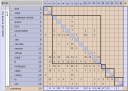
The persistence managers in the state subpackages are now outside the main section just like the non-virtual nodetype classes. After a short while of further research on the dependencies I found that the partitioning of the main state package would suggest that the item state managers be split to a separate package:

After creating a new statemanager package for containing the item state managers, the partitioning of the core module starts to look better. The only remaining circular dependencies are for the virtual core.A and core.B packages:

Looking at the virtual core.B package we find that only the NodeId, PropertyId, and ItemId classes depend on the state package:

In fact it seems that it might make sense to move the classes there. After doing that the core module partitioning looks even better:

The only remaining source of cyclic dependencies is the virtual core.A package into which I wont be going any deeper at this moment. Even now the analysis seems to have provided a number of suggestions for reducing the amount of cyclic dependencies and thus the improving the design quality of the Jackrabbit core:
Note that these suggestions are just initial ideas based on a quick walkthrough of the Jackrabbit architecture using a Dependency Structure Matrix as a tool. As such the approach only gives structural insight to the architecture, and for this short analysis I didn't much include knowledge about the semantic roles and relationships of the Jackrabbit classes and packages.
After receiving my Community license and struggling for a while to get the software running on Linux (need to include both the jars and the Lattix directory in the Java classpath!) I loaded the latest Jackrabbit jar file for analysis. The dependency matrix of the top-level packages after an initial partitioning is shown below:

The matrix contains all the package dependencies. A number in a cell of the matrix tells how many dependencies the package on the vertical column has on the package on the horizontal row. You can tell how widely a package is used by reading the cells on the package row. The package column identifies the other packages that the selected package uses or depends on. In general a healthy architecture only contains dependencies located below the diagonal.
The packages 2-6 form the general purpose Jackrabbit commons module, while the more essential parts of the Jackrabbit architecture are found within the core module. I grouped the commons packages and expanded the core module to get a more complete view of the Jackrabbit internals:

There was no immediate structure appearing, so I used the automatic DSM partitioning tool on the core module to sort out the package dependencies:

The value, config, fs, and util packages form a lower utility layer and the jndi package a higher deployment tool layer. The most interesting part lies between those layers, in the large interdependent section in the middle. The key to the architecture seems to be the main core package that both uses and is used by other packages in this section. I opened a separate view for examining the contents of the main core package:

The partitioning suggests that it might make sense to split the package in two parts. Without concern for semantic grouping, I just grouped the classes in the upper half as core.A and the classes in the lower half as core.B. This seems useful as the core.B package seems to be a bit better in terms of external dependencies:

Running the package partitioning again, I got a bit more balanced results although the main section still is heavily interdependent:

Looking at the vertical columns it seems like the main culprits for the interdependencies are the nodetype, state, version, and the virtual core.A packages. Both the nodetype and state package contain subpackages so I wanted to see if the dependencies could be localized to just a part of those packages:

This is interesting, the interdependencies for the state package are for the main state package, while the nodetype interdependencies only affect the nodetype.virtual subpackage. I split both packages along those dependency relations,and partitioned the core module again:

The persistence managers in the state subpackages are now outside the main section just like the non-virtual nodetype classes. After a short while of further research on the dependencies I found that the partitioning of the main state package would suggest that the item state managers be split to a separate package:

After creating a new statemanager package for containing the item state managers, the partitioning of the core module starts to look better. The only remaining circular dependencies are for the virtual core.A and core.B packages:

Looking at the virtual core.B package we find that only the NodeId, PropertyId, and ItemId classes depend on the state package:

In fact it seems that it might make sense to move the classes there. After doing that the core module partitioning looks even better:

The only remaining source of cyclic dependencies is the virtual core.A package into which I wont be going any deeper at this moment. Even now the analysis seems to have provided a number of suggestions for reducing the amount of cyclic dependencies and thus the improving the design quality of the Jackrabbit core:
- Split the main core package into subpackages
- Move the nodetype.virtual package to a higher level
- Move the state subpackages to a separate package
- Make a separate package for the item state managers
- Move the NodeId, PropertyId, and ItemId classes to the state package
Note that these suggestions are just initial ideas based on a quick walkthrough of the Jackrabbit architecture using a Dependency Structure Matrix as a tool. As such the approach only gives structural insight to the architecture, and for this short analysis I didn't much include knowledge about the semantic roles and relationships of the Jackrabbit classes and packages.
Monday, January 2, 2006
Implementing mRFC 0024
Today I wrote the mRFC 0024: Full text indexing in Midgard proposal for adding full text and content tree support to the Midgard Query Builder. Like Torben did for the MidCOM indexer, I'm planning to use Apache Lucene as the underlying full text engine. The search indexer process shall be based on the Lucene Java library, but I haven't yet decided what I should use for the query part. On the surface the best option would seem to be either the Lucene4C or the CLucene library, but both options have drawbacks. The Lucene4C seems like the best match for the midgard-core environment, but it doesn't seem to be too actively developed and there's even been talk of abandoning it for a gcj-compiled version of Lucene Java. The CLucene library is more mature, but it's written in C++ and might therefore cause some unexpected build issues for midgard-core. One option would of course be to actually try linking midgard-core with a gcj-compiled Lucene Java! I'll prototype with all these options tomorrow while the mRFC 0024 vote takes place.
Another interesting issue in mRFC 0024 is the introduction of the parent cache, or actually a global content tree structure. Currently Midgard supports a sort of a tree model for all content, but it is mostly accessible only as limited views like for example the topic, page and snippet trees. Functions like is_in_tree or list_..._all have also required major scope limitations or other performance hacks to be useful. This is a bit troublesome for many use cases like searching and access controlling. The proposed parent cache would greatly simplify such content tree operations.
If the proposed content tree model catches on, then a natural migration path for Midgard 2.0 would be to make the proposed parent_guid field the official parent link in all Midgard records. This would both simplify the object model and allow for much flexibility in organizing the content tree. It would for example be possible to create an event calendar topic that has all the event objects as direct descendants instead of having to use an explicit link to a separate root event. The only problem with this approach is that it is a major backwards compatibility issue...
Another interesting issue in mRFC 0024 is the introduction of the parent cache, or actually a global content tree structure. Currently Midgard supports a sort of a tree model for all content, but it is mostly accessible only as limited views like for example the topic, page and snippet trees. Functions like is_in_tree or list_..._all have also required major scope limitations or other performance hacks to be useful. This is a bit troublesome for many use cases like searching and access controlling. The proposed parent cache would greatly simplify such content tree operations.
If the proposed content tree model catches on, then a natural migration path for Midgard 2.0 would be to make the proposed parent_guid field the official parent link in all Midgard records. This would both simplify the object model and allow for much flexibility in organizing the content tree. It would for example be possible to create an event calendar topic that has all the event objects as direct descendants instead of having to use an explicit link to a separate root event. The only problem with this approach is that it is a major backwards compatibility issue...
Sunday, January 1, 2006
Network is the computer
I am sick and tired of doing backups, synchronizing settings, and having trouble accessing information. These are all symptoms of keeping your data locally on multiple computers. As a new year's resolution I have decided to get rid of all these problem.
So far I've tried to solve these issues by maintaining my own mail and web servers and keeping my data mostly on the servers. The problem with this approach is that I've never had (and probably never will have) the time to set up and maintain all the network services I'd need.
Thus I've decided to fully embrace the famous "Network is the computer" slogan by moving to fully external network applications for most of my daily information management.
As of today my Internet toolset will consist of the following:
The main reason why I haven't done this before is the question of data access and ownership. There is always the change of one of the service providers going down and taking the service with them. The external service interface also limits the things you can do with your data. Luckily with the recent emergence of various programmable APIs (REST, SOAP, etc.) these problems have become much less pressing. I can now write my own tools to import, export, and manipulate the externally stored data as easily (or even more easily!) as local data. This, I believe, is one of the cornerstones of the network as a computer.
So far I've tried to solve these issues by maintaining my own mail and web servers and keeping my data mostly on the servers. The problem with this approach is that I've never had (and probably never will have) the time to set up and maintain all the network services I'd need.
Thus I've decided to fully embrace the famous "Network is the computer" slogan by moving to fully external network applications for most of my daily information management.
As of today my Internet toolset will consist of the following:
- Gmail for email - jukka.zitting@gmail.com
- Wordpress.com for blogging - jukkaz.wordpress.com
- Flickr for images - flickr.com/photos/jlz
- del.icio.us for bookmarks - del.icio.us/jz
The main reason why I haven't done this before is the question of data access and ownership. There is always the change of one of the service providers going down and taking the service with them. The external service interface also limits the things you can do with your data. Luckily with the recent emergence of various programmable APIs (REST, SOAP, etc.) these problems have become much less pressing. I can now write my own tools to import, export, and manipulate the externally stored data as easily (or even more easily!) as local data. This, I believe, is one of the cornerstones of the network as a computer.
Subscribe to:
Posts (Atom)